
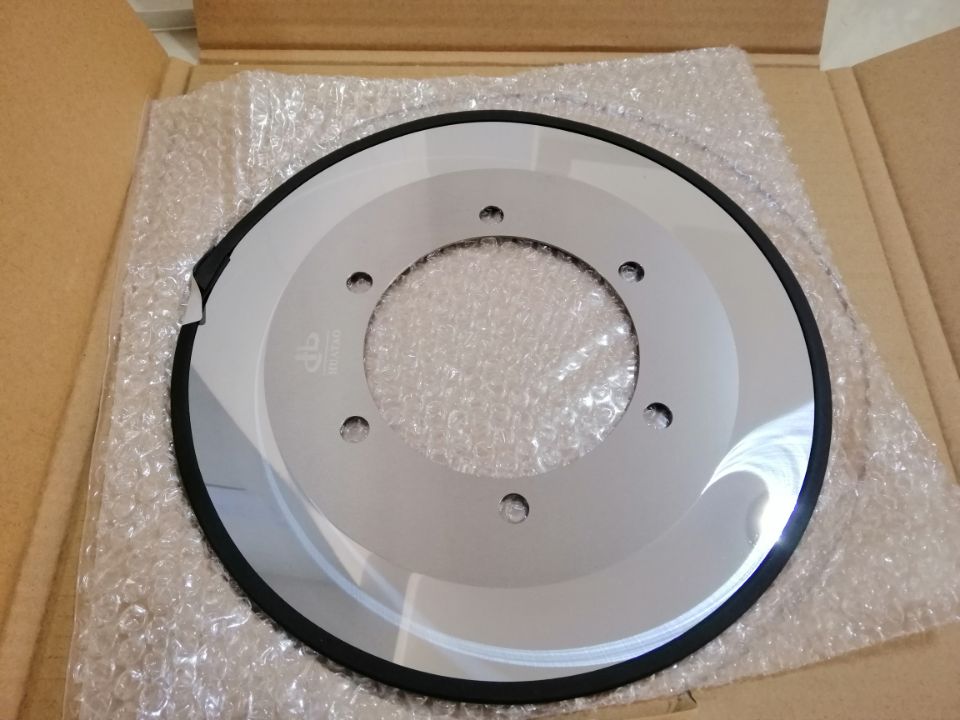
Recycled linerboard is not virgin board. It carries more mineral contamination and shorter fibers, which accelerate abrasive wear on slitting knife edges and make burr control harder to sustain over a production run. That single fact reshapes the material decision: the question is not simply "which steel is hardest," but which material retains a clean cutting geometry long enough on abrasive stock, and whether the supplier behind it can deliver that performance batch after batch.
This guide walks through material selection, the limits of supplier claims, factory audit questions, and how to compare two apparently similar Chinese suppliers.
Start by matching material to operating condition rather than to a catalogue headline.
D2 tool steel at 58–62 HRC is a practical baseline for standard recycled-content single-wall board. As recycled content and contamination levels rise, D3 or carbide becomes necessary. Solid tungsten carbide slitting knives in the 89–92 HRA range deliver significantly longer edge sharpness than conventional steel blades on abrasive corrugated board, reducing the frequency of burr-prone dull edges. Powder metallurgy HSS and solid carbide maintain stable edge geometry on high-speed corrugators better than standard alloy steels because they resist micro-abrasive wear from recycled fiber and starch adhesive.
A useful selection framework looks like this:
| Operating condition | Material to consider | Main trade-off |
| Long runs, abrasive stock, edge quality deteriorates as the knife wears | Fine-grain tungsten carbide, solid or carbide-tipped as permitted by the machine | Strong wear resistance, but sensitive to runout, misalignment and impact |
| Mixed production, or a setup where carbide suffers edge chipping | M2 high-speed steel; discuss a suitable PM-steel grade with the knife supplier | A practical steel alternative; paper-industry knife suppliers offer both HSS and PM-steel options |
| Low-duty production where purchase price matters more than time between sharpening | D2/SKD11 | Economical for general paper and board slitting, but less attractive for long runs of abrasive stock |
Two further points matter when verifying suitability. First, the wrong knife material causes dulling that turns shearing force into compression, producing burrs and liner delamination rather than clean cuts on recycled board. Second, high-recycled board grades often contain contaminant particles that create localized impact loads on the cutting edge; a material with higher toughness at the expense of peak hardness may outlast a harder but more brittle grade in dirty stock conditions. A supplier who only quotes a hardness number without asking about contamination level is not demonstrating suitability — they are demonstrating a price list.
Also confirm whether the board is being slit as a paper web on a rewinder or as part of finished corrugated board on a slitter-scorer. The two arrangements load the edge differently and should not receive the same recommendation. For machine-level review of the cutting station, see the Corrugated Slitter Scorer Machine and the standard Slitter Scorer product pages.
A claimed hardness alone does not predict burr performance on recycled linerboard. Consistent heat treatment and batch-to-batch metallurgical control determine whether a D2 or carbide knife actually delivers the wear resistance its grade suggests. Hardness reports are typically single-point measurements; they say little about uniformity across a batch or about the grain structure that governs edge retention.
Cutting sample videos have a similar limitation. A video showing a clean cut proves that one knife cut one sample cleanly under one set of conditions. It does not prove edge retention over a full run on abrasive stock. Ask instead for a trial structured around your actual conditions: a fine-grain carbide knife tested against your current blade, with the edge finish and geometry explicitly specified — not just "tungsten carbide." A machine-specific reference knife such as the FOSBER Tungsten Carbide Slitter Knife or the BHS Tungsten Carbide Slitter Knife is a useful benchmark; if the supplier cannot explain how their grade differs from these, the "grade" is a label rather than a controlled material.
Be equally careful with the assumption that harder is better. Tungsten carbide holds a sharp edge far longer on abrasive recycled material, but it is more brittle and less forgiving of machine vibration or misalignment than tool steel or HSS. A supplier who recommends carbide unconditionally, without asking about machine rigidity or alignment history, is not assessing your application.
The most valuable audit questions are the ones that separate a wear problem from a geometry problem, because both material selection and edge execution affect the result.
Ask about heat treatment control: how batch uniformity is verified, and what records accompany each lot. Ask about grain size and grade designation for carbide, and whether the grade is a paper-slitting grade rather than a general-purpose one. Ask how the supplier specifies bevel angle and edge finish for recycled linerboard, and whether they will supply the upper and lower knife as a matched system — for a shear slitter with an upper circular knife and a lower knife, the pair should be specified as a system rather than upgrading just one blade without checking compatibility. The Slitting Blade product range is a practical reference for how upper and lower knives are specified together.
Then bring your own operating data into the conversation:
Slitter make/model and whether it is shear, crush or another cutting arrangement
Knife dimensions and upper/lower knife materials
Linerboard grammage, caliper and running speed
Whether the defect appears immediately or develops with running time
Photos of both the slit edge and the used knife edge
A supplier who can interpret those details is distinguishing wear from geometry. A supplier who cannot is guessing.
Compare on total cost per square meter of board produced — accounting for blade life, changeover downtime and scrap rate — rather than on initial knife price. Two suppliers quoting the same carbide grade can differ substantially in real edge retention, and the cheaper quote often loses on cost per ton once downtime is counted.
Then test the diagnosis, not just the material. Use the timing of the defect to guide the comparison:
Clean with a fresh knife, then progressively fuzzy: this points toward edge retention, and trialling carbide is reasonable. Carbide's principal advantage here is resistance to abrasive wear.
Fuzzy immediately after installing a sharp knife: check the setup before buying a harder material — particularly excessive overlap, cant angle, runout, loose holders and web support at the cutting point.
Small chips on the cutting edge: investigate alignment and loading before specifying an even harder grade. Carbide can chip under misalignment or shock, and excessive cant angle can increase the risk of edge breakouts.
Do not apply a universal bevel angle or overlap setting without knowing the slitting arrangement. Excessive overlap is particularly harmful: it increases how much blade thickness the web must pass around and can increase dust and edge damage. Use the machine or knife supplier's settings for the actual blade diameter, profile and board grade.
Finally, recognize the limit of material change. On linerboard, what operators call "burr" may be a fuzzy, torn fibre edge. Knife wear matters, but cutting geometry and machine condition can also damage the edge — overlap, cant angle, runout, web tension and blade-holder rigidity are all established contributors to poor slit quality and dust. A supplier who will only discuss material, and never asks about your setup, cannot solve a geometry problem by selling you a harder knife. Line-level symptoms are frequently misattributed to the knife; before changing materials, rule out adjacent quality issues documented in Corrugated Cardboard Warping: Causes and Reasons and Solutions for Glue Opening of Corrugated Board.
Bottom line: for continuous slitting of recycled linerboard, fine-grain tungsten carbide in a paper-slitting grade, with a finely ground and polished cutting edge, is a sound first choice when the edge cuts cleanly after sharpening but soon becomes fuzzy or burred. It offers better abrasive-wear resistance than conventional tool steel and retains cutting geometry longer — provided the machine is rigid and accurately aligned, because carbide is more vulnerable to chipping. The supplier evaluation should test exactly that: whether the grade, the heat treatment, and the edge execution are controlled tightly enough to deliver the same result across batches. Buyers who also maintain the wider corrugating line will find related consumables in the Corrugator Machine Spares hub, and upstream roll maintenance guidance in Factors Determining Tungsten Carbide Corrugating Roll Life and Corrugator Belt Daily Maintenance.
FAQ:
What is the best knife material for slitting recycled linerboard?
For long runs on abrasive recycled stock, fine-grain tungsten carbide in a paper-slitting grade holds edge sharpness longest. D2 at 58–62 HRC is a practical baseline for standard recycled-content single-wall board. The right choice depends on contamination level, machine rigidity and run length. See Slitting Blade for compatible blade options.
Is tungsten carbide always better than tool steel for corrugated slitting?
No. Carbide resists abrasive wear better but is more brittle and less forgiving of runout, misalignment and impact. On machines with vibration or alignment issues, a tougher steel or PM grade may outlast a harder but more brittle carbide.
Why does my slit edge become fuzzy soon after sharpening?
Progressive fuzziness after a fresh knife usually points to edge retention, which justifies trialling carbide. Fuzziness immediately after installing a sharp knife points to setup: excessive overlap, cant angle, runout, loose holders or poor web support.
Can I trust a supplier's hardness test report?
A single-point hardness reading says little about batch uniformity or grain structure. Ask for heat treatment records, grain size and grade designation, and a trial against your own blade with edge finish and geometry specified.
What should I ask during a slitting knife factory audit?
Ask how batch uniformity is verified, whether the carbide grade is a paper-slitting grade, how bevel angle and edge finish are specified for recycled linerboard, and whether upper and lower knives are supplied as a matched system. Check the Corrugated Slitter Scorer Machine page to understand the full cutting station context.
How do I compare two Chinese suppliers with similar knife materials?
Compare total cost per square meter of board produced, including blade life, changeover downtime and scrap rate. Two suppliers quoting the same grade can differ substantially in real edge retention.
Does a harder knife always reduce burr on recycled board?
No. High-recycled grades contain contaminant particles that create localized impact loads. A material with higher toughness at the expense of peak hardness may outlast a harder, more brittle grade in dirty stock conditions.
What information should I send a supplier for an accurate knife recommendation?
Slitter make/model and cutting arrangement, knife dimensions and upper/lower materials, linerboard grammage and caliper, running speed, whether the defect appears immediately or develops over time, and photos of both the slit edge and the used knife edge.
Related content using approved internal links:
Call to action and approved contact information:
market@huataogroup.com
Mobile +8618033763037 (wechat & whatsapp)
Hashtags: #SlittingKnives #CorrugatedBoard #TungstenCarbide #RecycledLinerboard
can not be empty
can not be empty


Web: www.htwirebelt.com
TEL : +0086 0311 80690567
EMAIL:market@huataogroup.com
WhatsApp & WeChat :
+86 18033763037