
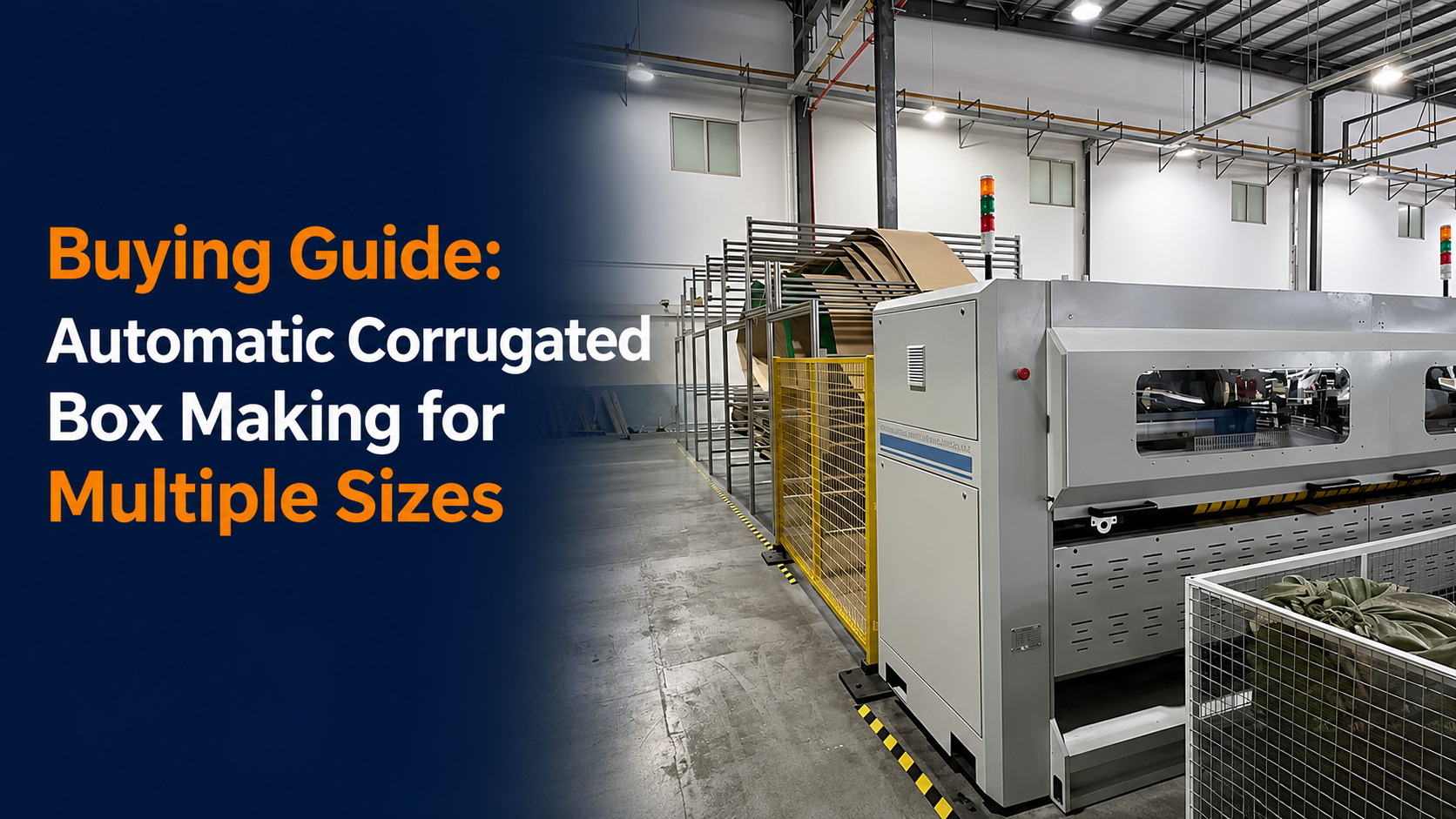
Procurement teams evaluating equipment for multi-size corrugated box production usually start with machine brochures and end with a harder question: which of the three competing routes actually fits our order book? This guide compares the routes on their merits, explains the fanfold-fed system that has become the reference answer for size diversity, and closes with a checklist you can put in front of any supplier.
"Making boxes in different sizes automatically" bundles three separate requirements, and most buyers need them in different proportions:
Pull these three numbers before contacting any vendor. They decide the answer more than any machine specification does. A plant with 200 orders per week across 60 sizes is shopping for a different machine than a plant with 30 orders across 8 sizes.
Route 1 — Modern sheet-fed flexo folder gluer. The incumbent. Current machines have shortened routine size changeovers to minutes with tool-free crease changes and servo feeds. Strengths: proven technology, inline printing, high top-end speed on stocked sizes. Structural limit: it consumes pre-cut sheets, so the plant's size variety is capped by its sheet warehouse, and someone must forecast that warehouse months ahead. Every mismatch between forecast and reality becomes trim waste or a lost job.
Route 2 — Digital cutting table. Any design, any size, one-off, no dies. Strengths: absolute flexibility for samples, displays, and very short runs. Limit: throughput — one sheet at a time, at cutting speeds far below rotary lines. It answers "any size" brilliantly and "how many" poorly.
Route 3 — Fanfold-fed automatic box making. The system route. Upstream, the corrugator dry end scores the web at a fixed crease pitch and a fanfold corrugated stacking machine folds it into one continuous accordion stack; the board is never cut into discrete sheets. Downstream, an automatic fanfold corrugated box making machine pulls the stack, separates sheets at the crease, and drives every creasing, cutting, and gluing position from the job program. Sheet length becomes a decision made at the point of order, not the point of production.
 Route 3 is the only one of the three that removes the fixed sheet at the source. That is why it keeps coming up whenever the first question — size variety — is the dominant one.
The system has two halves, and they must be evaluated together:
The dry-end half. Rotary scorers press fold creases into the moving web at the programmed pitch — chosen to bracket the plant's real order-length distribution. The fanfold corrugated stacking machine folds the scored web into a dense, alternating stack, discharges it at the programmed count or height, and starts the next pile without stopping the web. The two quality factors are crease pitch accuracy and fold alignment, and both depend on belt synchronization with the web. Equipment detail: fanfold corrugated stacking machine, with the surrounding family in the fanfold solutions category hub.
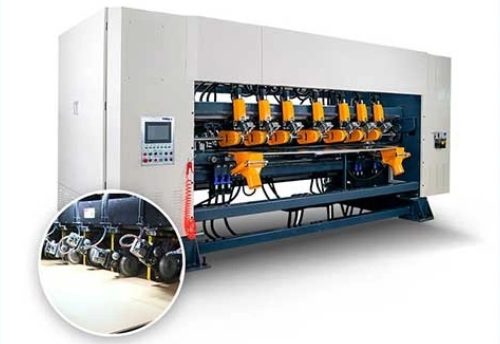
The converting half. The box maker separates the called-up number of sheets at the crease and feeds them through program-set creasing, slotting or cutting, gluing, and (where needed) inline flexo printing, then counts and stacks finished boxes automatically. No mechanical size setup stands between two different box sizes — the change is a job parameter.
The timing argument has sharpened this year. Containerboard prices moved up through three announced increase rounds in 2026, and by autumn board prices were running roughly 20% above year-earlier levels — about USD 170 per tonne on linerboard and USD 200 per tonne on corrugating medium through September. In November 2026, major packaging-paper mills announced yet another increase of around 50 yuan per tonne on corrugating grades, effective in stages from mid-month. For converters with limited pricing power, the losses that respond to this route — trim waste on mismatched sheets, capital tied up in a multi-size sheet warehouse — are no longer background noise. They are line items growing at commodity speed.
Machine brochures cover the board and the converting; the third component of the system — order data — rarely appears in any of them, yet it decides whether "automatic multi-size" survives contact with production. The chain looks simple on paper: the order system holds length, width, depth, flute, and style for each job; the box maker receives those parameters as a file; no human retypes anything.
In practice, buyers should trace the chain physically during the demo. Where does the job file originate? Does the machine's controller import it natively, or does an operator key the values in from a printout? Who is responsible when a re-typed order produces a wrong box — the order desk or the converting floor? At high order volumes, a manual re-entry step costs a few seconds per job; at short-run volumes, it costs something worse: a whole error class. One mis-keyed depth can wipe out a day of changeover savings and a customer relationship in the same afternoon.
The same trace applies upstream. The scorer's pitch settings, the stacker's count and height, and the box maker's job queue should all draw from the same order data source. Plants that integrate this layer during the initial installation report smoother ramps than plants that treat it as a phase-two project — by which time operators have built habits around keyboard entry that are hard to unlearn. Budget the integration like a real component: with a specification, a test plan, and an owner.
Plants planning for the fanfold route should expect a sequence, not a switch:
Weeks 1–4: data and layout. Order-history analysis, board-flatness review, dry-end floor plan, and the pitch strategy derived from real order lengths.
Weeks 5–12: manufacturing and site preparation. Equipment build runs in parallel with site work — foundation, utilities, transport routing between dry end and converting.
Commissioning: trials on your board. Acceptance runs use the plant's own board mix, measuring door-to-door changeover time and waste-until-acceptance at every size transition. This is also where stack quality evidence is gathered — pile alignment, edge squareness, crease integrity.
First production month: order migration. The most size-diverse, short-run order families move first, because they exercise exactly the capability the system was bought for. Long-campaign work stays on the sheet-fed line meanwhile; most plants keep both.
Plants that skip the order-history step and buy on specifications alone are the ones most likely to discover, after installation, that their real bottleneck was something else entirely. The checklist below exists to prevent exactly that outcome.
Put the same six questions to every bidder:
For the commercial side — how short-run economics change once size setups disappear — the technical guide How Box Manufacturers Handle Small Orders Profitably works through the arithmetic with worked examples.
Not every plant should buy this system. Long-campaign plants serving few large customers are usually better served by a faster sheet-fed line. Plants with unresolved board-flatness problems should fix flatness first — a fanfold stacker amplifies whatever it is fed. And plants without dry-end floor space for a folding stacker are looking at a rebuild, not a retrofit.
The right first step costs nothing: send your corrugator model, working width, board mix, and recent order-size distribution to the equipment supplier and ask for a configuration review — with the explicit request to say no if the numbers don't work.
Contact: Chris Xue | HUATAO GROUP
Email: chris@huataogroup.com
WhatsApp: +86 19322109200
Website: www.htwirebelt.com
can not be empty
can not be empty


Web: www.htwirebelt.com
TEL : +0086 0311 80690567
EMAIL:market@huataogroup.com
WhatsApp & WeChat :
+86 18033763037